
Mission
Same in English?


It’s been about 11 months since I started the Hungarian version of this project called “Electoral Knowledgebase” (Választási Tudásbázis). In fact, it didn’t start as a Substack newsletter but as a very basic website where I wanted to assemble key information about my favourite subjects: elections, voting, and democracy.
The main reason I started this project was that in Hungarian, my native language, this field has some huge gaps, even (or especially?) on the entry level. For example, Hungarian Wikipedia consists mostly of awkward translations of older versions of the English articles, if anything. Most other sources that people who do a quick search on the subject in general might find are just over-simplified rehashings of the “common knowledge” that is taught even at universities. I suspect this must be the case with other languages too, that the amount of information available about more specifics on the subject is very much grounded in the status quo of the countries that use that language. In Hungary, there are of course experts who have a decent understanding of voting theory in general, but when they write about it outside of academic articles, it usually does not stray much further from systems currently or formerly in use in the country. This is somewhat understandable, since it provides them with some relevance and also avoids introducing too many concepts that might be confusing for the reader, or could easily be perceived as irrelevant. However, I would argue that it is not neutral to stick to the locally better-known concepts. To present the topic faithfully, we should always aim to do better than that and take a more holistic view of the subject.
There are even deeper problems in the Hungarian case: the existing language itself is pretty limiting. Some concepts don’t or barely have an established translation, like the single transferable vote (STV), panachage, or even approval voting. Still worse, some terms, like bloc voting (infuriatingly codified under a name meaning “individual list” or previously “small list”), have very unfortunate counterparts, and often problematic conflations are made (like “list systems” being synonymous with proportional representation). Of course, the English language is not free from these problems. In fact, it might have even more, since terminology varies between the UK, the US, India, Australia, and New Zealand, for example (e.g., instant-runoff known as the “alternative vote” [AV, which also stands for approval voting], “ranked-choice voting”, “STV”, and “preferential voting”). However, in these cases, the problem is more often caused by too many competing and confusing terms, while in Hungary, at least half the problem is the lack of any familiar words. I look at this as an opportunity too: While I might have to accept that “transfer votes” will now be irreversibly known as “fractional vote” votes (which can be critiqued from a few angles), but where no terms have taken root, I may be able to add some value. And I do think there is value there, since more descriptive terms can make the whole topic more accessible. Talking about the Sainte-Laguë method (also known as Webster’s method) of apportionment and Condorcet winners makes the subject seem even more nerdy than it is. Not that Condorcet himself doesn’t deserve to be better known, but maybe his legacy would be better served if his principle were more widely known under something like “generalised simple majority rule” or “beats-all majority winner”. Maybe even if some of these concepts were at least marginally more approachable, they would be more likely to be seriously considered in practice, too.
In the past year, this project has progressed slowly in terms of my original objectives, but it has prompted me to seriously engage myself with many possible adjacent goals. I have contacted many people in Hungary who had similar ideas or are considered experts in this field — this was a very positive experience, which spawned even more side-projects. I also got in touch with most municipalities that have a participatory budgeting (PB) program about improving their voting methods. This effort does not have tangible fruits - yet - but in general also had surpassed my expectations. I also got more engaged with the (worldwide) academic fields of electoral studies in political science and computational social choice. I also pivoted from my (originally both a bit naïve but more importantly, narrow, abstract) topics to regularly writing about elections happening in the world at the time. Around July, I started up the Hungarian version of this Substack, since I was advised that it might be a more natural fit for the longer “articles” I was writing (compared to the social media I started out experimenting with).
Now I am starting an English version, which for the moment will be standalone (no companion pages on other social media, nor will I build the “Knowledgebase” as an English site for now, since such things already exist). Much of the content will be in parallel with the Hungarian version, especially the explainers about the electoral systems of various countries. However, the overlap may not be 100% since, on the one hand, I will probably not translate every niche, Hungary-centric article. On the other hand, I might start writing on topics in English first and foremost. One idea I already have is to present academic concepts, especially the newer research (such as in the field of COMSOC), in a (hopefully) accessible way.
Otherwise, the main principles I started out with about a year ago, I intend to follow here too: To try to present the importance of voting rules and a wider range of possibilities in democratic decision-making (also beyond voting, like sortition, deliberative democracy). To integrate the subject area that is often fractured into the peripheries of the different fields that deal with it: mathematics, economics, political science, law, computer science… To try to raise questions and avoid overly dogmatic approaches. A motto I had for this project, about 2.5 years before I actually started it was also the title of a guest lecture I gave on the subject, “There is no Royal Road… [to Democracy]”. This obviously alludes to the obstacles that make this field even theoretically challenging (let alone in practice…), such as Arrow’s theorem and such. It also evokes Euclid’s quote, which applies here too, I think, one has to grapple with hard questions and have some humility alongside the enthusiasm. At the same time, I want to avoid false neutrality, so while I may not have the definitive answers, I will try to be open about what I am partial towards or against. Both for the sake of transparency and to make it clear that just because I don’t believe in one universal solution doesn’t mean anything goes wrong. If that were the case, I wouldn’t be writing about it…
So I hope you will enjoy reading my ramblings on voting and stuff. If you don’t want to miss it, here comes the first subscribe button:
About the logo

In case you are wondering, what is this beautiful logo? — It is, of course, my own design and has some meaning. I am interested in people’s intuitions of fairness, and this logo symbolises a “puzzle” of voting:
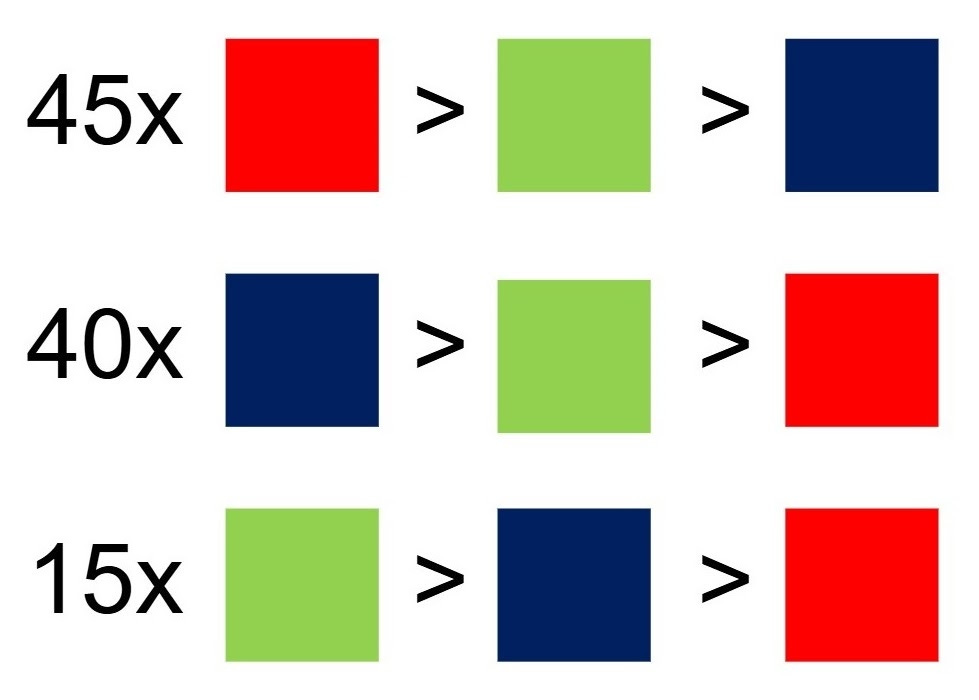
The question is, based on the (sincere) preferences of a society like this (but instead of 45, 40 and 15 people, it may as well be 35, 34 and 31 or 49, 48 and 3), who should be elected. This simplified example does sort of show whether someone is committed to
first-preference only (~FPTP) rules (it’s quite common that people even deny the legitimacy of multiple preferences per voter in politics, declaring that if you cannot make a clear choice, what are you even doing — of course, I disagree wholeheartedly with this mindset) and thus thinks Red should be elected,
a top-heavy but some sort of majority seeking rule, or maybe one level deeper, some rule in the later-no-harm pradigm, like instant-runoff or the two-round system. Many intuitively think that, with these ratios, the serious contenders must be Red and Blue, but Blue should ultimately win because it clearly has more support among the entire electorate than Red. It might be something to do with assuming that first preferences are much stronger, and we should not weight lower preferences the same, since those are about lesser evils. A common argument is that we don’t want a system that elects a dark horse — an unknown candidate nobody really wants, or even a bland candidate who only wins because nobody really hates them.
more compromise-seeking or at least holistic rules in general, but really, Green is the winner not just under Condorcet or Borda, but most ranked single-winner devised (notably except for the later-no-harm ones).
Of course, even more exciting is when someone thinks more critically and questions whether there’s enough information, for example, because cardinal utilities are missing.